
Neverness to Everness vs Genshin Impact: What Is Actually Different?
NTE and Genshin Impact both put four-character teams in an open world, but the setting, combat feel, and gacha system diverge more than the "clone" talk suggests.
 By Ria Amano SEP 15, 2026 8 MIN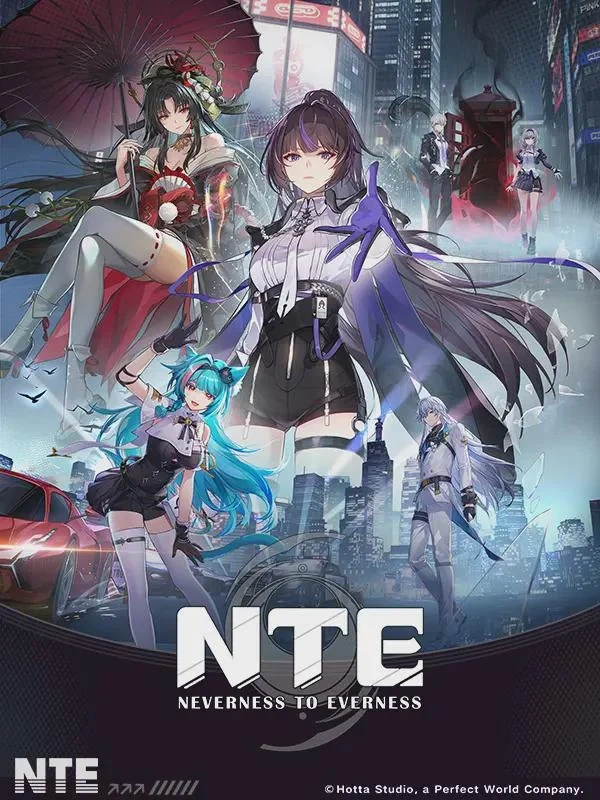
Quick answer
NTE and Genshin Impact both put four-character teams in an open world, but the setting, combat feel, and gacha system diverge more than the "clone" talk suggests.
- Focus
- Comparisons
- Game
- Neverness to Everness
- Reading time
- 8 MIN
The "NTE is just Genshin with cars" take gets repeated so often it's worth actually testing. Both games share a real structural backbone, four-character teams, elemental-style synergy combat, an open world, and a gacha economy, so the comparisons aren't unfair. But once you get past the shared skeleton, the two games are solving different problems for different players. Here's the honest breakdown.
The Shared DNA
Genshin Impact (miHoYo/HoYoverse, launched 2020) and Neverness to Everness (Hotta Studio, launched worldwide April 29, 2026) are both free-to-play, real-time action RPGs built around swapping between a party of up to four characters mid-combat to chain attribute-based reactions. Both are open worlds you explore on foot, with traversal abilities gated behind stamina. Both monetize primarily through gacha character banners.
If your only reference point is "elemental combos in an open world," you can see why the shorthand exists.
Setting: One City vs. Seven Nations
This is the clearest, least arguable difference. Genshin's Teyvat is a fantasy continent split into distinct elemental nations, Mondstadt, Liyue, Inazuma, and beyond, each built around ancient ruins, ley lines, and elemental Archons. Four-plus years of updates have made it enormous: hundreds of hours of world content already exist.
NTE commits to the opposite scale choice: one modern city, Hethereau, built dense rather than wide. Instead of new continents, NTE expands through new districts within the same urban footprint (New Herland, Miguel, and others added post-launch). There's no equivalent to Teyvat's regional Archon structure, NTE's overarching threat is investigative and cosmic-horror-flavored rather than mythic.
Combat: Elemental Reactions vs. the Esper Cycle
Genshin's combat depth comes from its elemental reaction table, Vaporize, Overload, Electro-Charged, and so on, refined over six years into one of the deepest systems in the genre. It rewards long-term system mastery and team-building theorycraft.
NTE's Esper Cycle asks for something more skill-timing-based: characters carry attributes (Lakshana, Cosmos, Anima, Incantation, Chaos, Psyche), and chaining two adjacent attributes in combat triggers a synergy burst. Multiple outlets have described the resulting feel as sitting between Genshin's steadier pacing and Zenless Zone Zero's faster swap-chaining, more forgiving than ZZZ, more actively skill-expressive than Genshin's baseline rotation.
Neither system is objectively "better", Genshin rewards knowing the reaction chart, NTE rewards reading the fight and swapping on reaction.
Gacha and Monetization: The Real Gap
This is where the two games diverge most concretely, and it's the point NTE's marketing leans on hardest.
| NTE | Genshin Impact | |
|---|---|---|
| S-rank/5-star base rate | ~0.99% | ~0.6% |
| Soft pity starts | Pull 70 | Pull 74 (character banner) |
| Hard pity | Pull 90 | Pull 90 |
| 50/50 mechanic | None, hard pity always goes to the featured character | Yes, with a guaranteed win on your next 5-star if you lose the 50/50 |
| Worst-case pulls for the featured character | 90 | Up to 180 (if you lose the 50/50 once) |
In plain terms: Genshin's system is well-understood and has a safety net (you're guaranteed the featured character on your second 5-star), but a genuinely unlucky run can cost double the pulls. NTE removes that coin-flip entirely, pity always lands on the featured unit, which is the single biggest reason players call its system more generous, even though its base pull rate is only marginally higher.
Content Volume: No Contest, and That's Expected
Genshin has years of accumulated story, world quests, and systems. NTE launched in April 2026. Judging total content volume against a six-year-old live-service game isn't a fair fight, and it isn't the point, NTE's pitch is a different experience, not a bigger one, at least not yet.
Graphics and Hardware
Genshin uses cel-shaded rendering that runs comfortably on modest hardware, which is a big part of why it works so well on mobile and Switch. NTE leans toward a more realistic rendering style, Unreal Engine 5.7 with ray tracing and DLSS 4 support at launch, and asks more of your hardware in exchange for its city's lighting and material detail.
Platforms
Genshin covers PC, mobile, PlayStation, and Nintendo Switch. NTE launched on PC, PS5, iOS, and Android, with no Xbox or Switch version confirmed at the time of writing.
So, Which Should You Play?
- Pick Genshin Impact if you want a mature, content-dense fantasy world with a deep, well-documented combat system and an enormous existing community.
- Pick Neverness to Everness if the idea of a single, richly detailed modern city, complete with drivable cars and a more forgiving gacha system, sounds more interesting than another fantasy continent.
- Play both. Their daily loops don't overlap much, and both are free. Reviewers managing roughly 30–40 minutes a day across both report no real conflict.
NTE isn't a clone chasing Genshin's numbers with a reskin, it's a different bet on what an open-world gacha RPG should look and feel like, built by a studio (Hotta Studio) that's iterated on this formula before with Tower of Fantasy.
Related Reading
- Want the full picture on NTE first? See our Origins hub: [Neverness to Everness: Everything We Know About NTE].
- Curious what shaped NTE's visual identity? Read our piece on the Origins category: the anime and urban fantasy influences behind NTE.
- Looking for other games in this space beyond Genshin? Check our Recommendations list of games like NTE.
Sources
- Android-Zone.fr, "Neverness to Everness vs Genshin Impact : quel open-world choisir ?"
- GameRant, "Neverness to Everness: Why NTE Will Give The HoYoVerse A Run For Its Money"
- nteguide.com, "Neverness to Everness vs Genshin Impact: Complete Comparison (2026)"
- ntegame.net, "Neverness to Everness vs Genshin Impact vs Zenless Zone Zero: A Complete Comparison"
- nte-guide.com, "NTE vs Genshin Impact, Which Should You Play? (2026)"
- Perfcore, "Neverness to Everness Review: Worth Playing in 2026?"
Ria leads GamingMor’s story-first coverage of games, anime and the people behind them.